

Mutualism or domination?
It is never too late to choose better ways of relating...

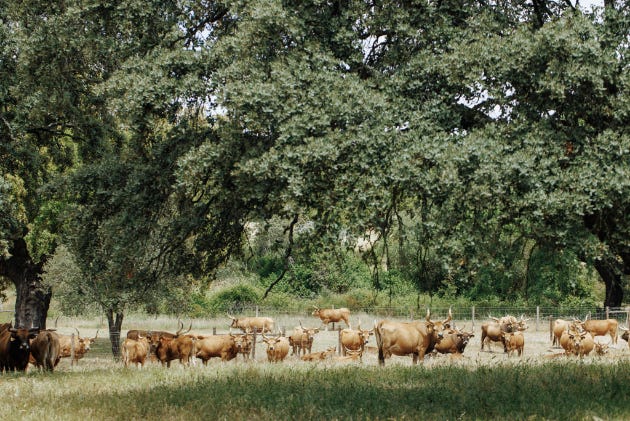
Who do we think we are, us humans? It is funny in a way; our sense of omnipotence, because the truth is that we are part of an inordinately complex relational reality. This doesn’t seem to stop us from trouncing on our own life support system, though. Kew reports that 45% of all known flowering plants are potentially threatened with extinction; the main threats being habitat loss and land use change (human-driven). Yet, we continue to function as though we are the most powerful species and that we can do what the hell we want in relation to all other species. Come to think of it, many humans feel entitled to do what the hell they want to other humans, too.
It can be a bit strange to be a specialist in plants and microbes when, for so many humans, neither really register on their radar, despite our essential dependence upon them. Last month, I talked a little about the microbe side of things and how very entwined our existence is with theirs. This week, it’s the turn of plants. Like it or not, one way or another, we depend upon them.
I am not going to point out that they are responsible for providing much of our oxygen, helping to sequester carbon (thereby influencing climate) or that food chains all depend upon plant matter. I am not going to dwell on their role in soil formation or nutrient cycling, the water cycle and temperature regulation, habitat provision or their role in providing humans with medicine. No, I won’t mention any of that. Instead, I am going to talk about a recent experience where I witnessed human and plant mutualism first hand. It stood out for me because it is increasingly rare to see.
A few weeks ago, I was teaching on a ferment intensive in Portugal, organised by Ferment Academia. On the first day, we visited Montada do Freixo do Meio. Alfredo, a third generation custodian of this incredible ecosystem, showed us around. There is something both moving and unnerving about meeting people who belong to their natural environment. Their rootedness is palpable. And that emphasises what so many of us have lost.
Montado is a traditional, low-intensity agrosilvopastoral method of farming in Portugal, particularly dominant in the southern Alentejo region. It is a multifunctional landscape that merges forestry, agriculture, and livestock grazing (that is what agrosilvopastoral means) in a savannah-like ecosystem. This particular ecosystem is characterised by Cork oak (Quercus suber) and Holm oak (Quercus rotundifolia). They harvest the cork from the Cork Oak and acorns from the Holm Oak. This is a dynamic ecosystem, which includes humans, trees, other plants, animals and other beings that fulfil functions required by the ecosystem. Alfredo’s approach is guided by the visions of agroecology, permaculture and food sovereignty. The aim is to ensure ecosystem preservation and sustainable food production without resorting to processes alien to the natural system and, at the same time, mitigating climate change. This landscape now hosts over 1000 catalogued species, both wild and domestic, of high ecological importance.
Cork Oak trees differ markedly from other trees regarding the structure and regeneration of their bark, particularly in how they produce and manage the tissues that comprise it. I had never met a Cork Oak until now. I am 53. Have you ever met one? What an amazing and unique tree. If any plant exemplifies why we should be working with plant intelligence and complexity, it is Cork Oak. Power with, rather than power over.
Paid subscribers, read on to find out more about Cork Oak and why we could all do with paying more attention to plants.